

We asked 16 leading NBA voices on Substack:
From this incredibly newsy summer ...
Your take on one development (or more) that will continue to resonate.
Check out their answers and subscribe!
Marc Stein | The Stein Line
I will occasionally meet new people who want to know more about what I do and they often leave me with the impression that they don't fully believe me when I tell them that tracking the NBA has essentially become a 24/7/365 enterprise.
I'd argue that this summer has slammed that reality home as much as any. We're past mid-August on the calendar and I landed last Friday afternoon in London for a bit of a soccer-watching escape … only to be immediately greeted by news of yet another team sale (Minnesota) and a Klay Thompson buyout in Dallas and a DeMar DeRozan signing in Denver. I made the joke in a recent story that the NBA's schedule release earlier this month barely qualifies as a top-10 story in August because of all the recent headlines.
Let's just say that the upcoming Board of Governors session scheduled for mid-September ... really wish I could eavesdrop on that one. What are they going to dig into first? The sale dramas enveloping the Lakers and Timberwolves ... on top of the nearly yearlong Clippers investigation ... with uncertainty also surrounding the Trail Blazers' future in Portland?
We also await updates on the state of NBA Europe and domestic expansion ... and a response to leaguewide consternation with the first and second aprons ... and hopefully a hint or two about what the league office has planned to help the WNBA manage its constant chaos.
Please don't ask me to pinpoint the most significant or concerning issue because I think they're all pretty damn concerning. #thisleague
Keith Smith | The Basketball Bulletin
Maybe it’s because it’s what I’m closest to, but I can’t see the topic of the second apron and player salaries going away anytime soon.
Front office personnel, owners and the league itself have been pushing back, correctly so, on the idea that players are getting less money. That argument started when the current CBA did, but players still get their 51% of BRI.
But many feel like it’s maximums or minimums and nothing in between. How do you legislate a feeling but to fight it with facts? It’s a debate that will continue.
Also sticking around for a while: Expansion. Until NBA expansion is a thing or isn’t a thing, it’s going to be a popular topic of discussion. It’s time for Seattle to have a team again. Las Vegas seems very motivated. Local TV rights seem to be settling. Feels like expansion is inevitable, with the only question being when.
Mark Whicker | The Morning After
I really don’t know what’s so hard about this. Seattle is still bleeding from the loss of the SuperSonics, and now it has a spiffy, fairly new arena. Las Vegas is the de facto home of basketball in the U.S., the place that the game automatically goes when you let go of the wheel. If you must expand, those are the only two choices.
But for basketball lovers, expansion is poison. There aren’t enough players, particularly Americans, to stock 20 good teams, let alone 32. That’s with only one expansion team (Charlotte) since 1995.
A 12-team relegation league, similar to the PGA Tour’s new Challenger Series, would be just the thing, sponsored by Ro (right, Charles, in pill form).
Neil Paine | Neil’s Substack
The Kawhi/Clippers scandal is going to linger for a while, no matter whether the league wraps it up soon — poor Toronto is still waiting — or whether the recent ESPN report that the NBA’s investigation “found no evidence” Steve Ballmer funneled money to Kawhi through team sponsors proves to be accurate.
The mountains of circumstantial evidence uncovered by folks like Pablo Torre will ensure that no official exoneration from the league is enough to make this story disappear anytime soon.
Katie Heindl | BASKETBALL FEELINGS
This is more of a between-the-lines development league-wide, but with the reverberations of the investigation into the Clippers, Tom Dundon’s penny-pinching tenure thus far in Portland, and the Lakers swapping hands again like a hot, billion-dollar potato, I see the rift between fans and their favourite teams getting wider.
Also between fans and the league itself. It was always a ruse that fans had access to athletes, but athletes still felt, for the most part, accessible. They are laid bare in front of us on the court every night, and they put themselves out there via social media when they aren’t.
Fans have always known they aren’t of the same economic ilk, but the skyrocketing of valuation in and around the NBA, indeed the way money’s been made to feel paltry (Steve Ballmer is not losing any sleep, Dundon doesn’t need to be so cheap), feels closer to the rumblings of a class war in the making than bringing everyone in under the same, big basketball tent.
Jake Fischer | The People’s Insider | Contributor to The Stein Line
Denver may be the most interesting team in the league this season.
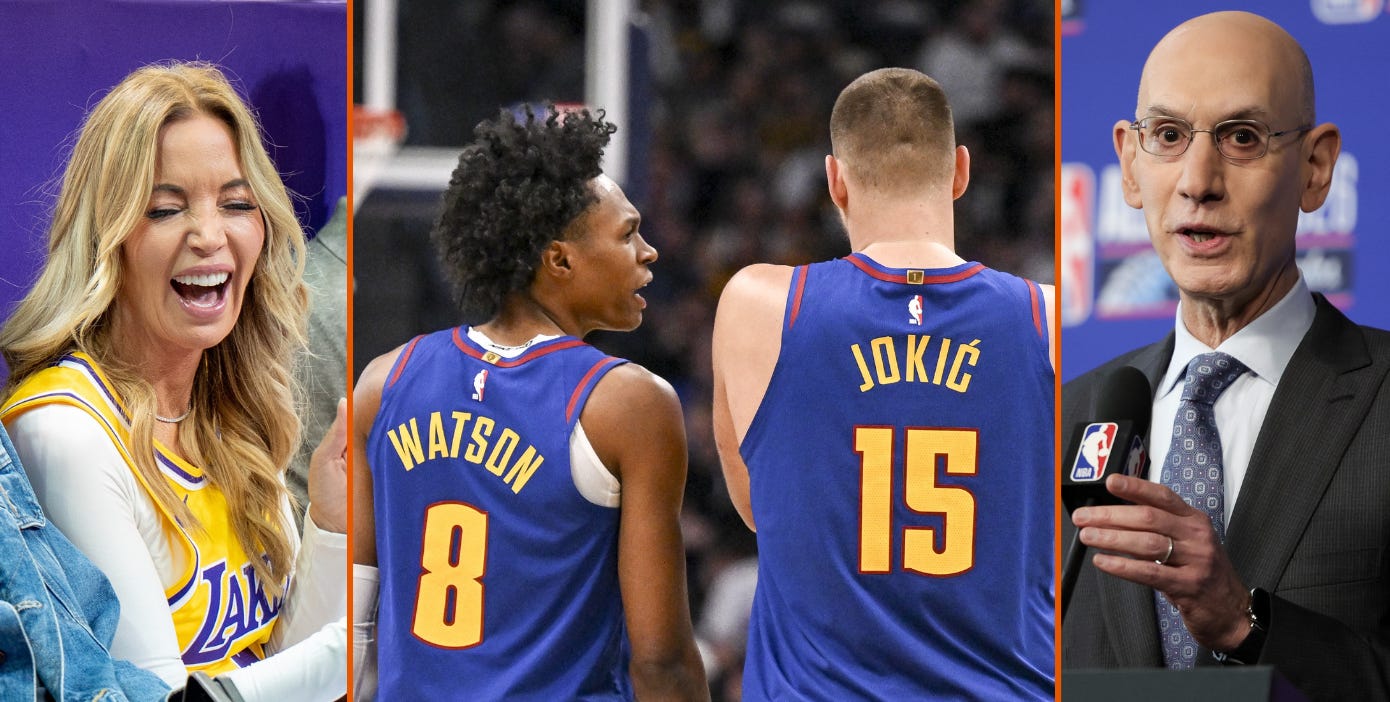
The Nuggets speak internally about how they want to do right by Nikola Jokić and maximize his prime as one of the greatest players in NBA history, but allowing Peyton Watson to walk in restricted free agency to the tune of just four years, $88 million would seem to run quite contrary to that notion.
I’ve been told Denver personnel saw a lot of the negative feedback on social media about returning Cleveland’s 2031 unprotected first-round pick and some additional draft capital in exchange for Watson. That return wasn’t close to the multiple firsts Utah received for Walker Kessler, which set the Nuggets’ original asking price to part with Watson via sign-and-trade.
I do see some logic in the Nuggets’ thinking, though. They are still dealing with the sour taste of Zeke Nnaji’s four-year, $32 million contract that is still going, through 2027-28, and did not want to risk Watson’s new deal resulting in an overpay off a very strong January sample size that really amounted to only 15 games of brilliant ball. The trade market this summer — outside of the Suns splurging for Miles Bridges — revealed teams aren’t trading first-rounders for strong starter-level players in this economy and with these new lottery reform rules. From Isaiah Stewart to Isaiah Joe, guys are going for roughly three seconds, maybe four.
And so, the Nuggets now have a future Cavs pick to essentially go and get any contributor they’d like to aid Jokić, Jamal Murray, Aaron Gordon and company. I am just a little skeptical what reinforcements are really so plausible for Denver to net back, when they only have Nnaji’s money plus Cam Johnson’s expiring $23 million to bring back roughly $30 million along with that 2031 pick.
Is that formula going to be good enough to compete in the West? And then, will it be good enough to convince Jokić to sign an extension next summer, and truly be a Nugget for Life?
Yossi Gozlan | Third Apron
Nikola Jokić’s future feels officially in play after the Nuggets didn’t retain Peyton Watson.
Matching Watson’s four-year, $88 million contract would’ve elevated their $300 million roster to $450 million when factoring in additional payroll and luxury tax penalties. This is the most critical time to show Jokić they’re serious about contending for championships, and they should’ve bit the bullet this season.
He is probably planning on re-signing with the Nuggets next offseason, but a lot could change over the next 10 months. He will hold a tremendous amount of leverage over his future not just with the ability to sign with any team as a free agent, but the ability to force a trade to a specific destination with his player option.
Jonathan Macri | Knicks Film School
My eyes remain glued to Portland and the current drama with the Blazers.
I usually don’t concern myself with owners trying to line their pockets, but where significant NBA history is concerned, it matters quite a lot. The Trail Blazers have been a vital part of the fabric of the league for so long, and the relationship those fans have with their team is special.
If they moved, it would be the most significant black eye for Adam Silver’s regime to date. Let’s all hope it doesn’t happen.
Charley Walters | DON’T PRINT THAT
An informed source told me in 2024 that Marc Lore and Alex Rodriguez didn’t have the $1.5 billion they agreed to pay Timberwolves-Lynx owner Glen Taylor to buy the franchises. The pair was bailed out by billionaires Michael Bloomberg and Eric Schmidt, who joined the group during the fight with Taylor, and subsequently won a favorable arbitration.
The NBA requires majority owners to have at least 15 percent interest in a purchase.
Last week, Lore gave up controlling interest in the Timberwolves, now suddenly with a valuation of $4.5 billion, presumably because he wanted to focus on other business ventures. This time, he sold to Marc Stad, a Harvard grad who heads an equity firm based in San Francisco — and who was already a minority investor in the teams.
Stad, pending NBA approval, will become controlling owner of the Wolves-Lynx. Stad’s wife Elisa will replace Lore as Timberwolves governor. Rodriguez is increasing his stake and stays on as Lynx governor.
Lore, who reportedly will become a minority partner, could end up tripling his initial investment.
Although on a smaller scale, Lore’s Wolves-Lynx transaction doesn’t seem dissimilar to what’s taking place with the controversial sale of the Los Angeles Lakers.
Hardwood Paroxysm | Hardwood Paroxysm
Between 2015 and 2022, only four NBA teams were sold. In the last three years, there were nine NBA team sales (including the Lakers twice). Front Office Sports reported that insiders don’t believe there’s a singular reason for this sudden boom; they believe it’s all individual circumstances.
I’m not so sure. Whether we’re seeing early signs of a more severe economic turn that has various billionaires ensuring their windfalls or an increasingly lax approach by the league to who gets to hold the most prestigious properties in basketball worldwide, something is up with this kind of change, and it’s not hard to feel like the wind is sour for one reason or another.
Who’s next?
Jacob Sutton | JSuttHoops
The venture capitalization of the NBA is reaching a peak. Mark Walter’s legal status aside, owners have realized that the NBA is primed for startup-esque investment strategies.
Marc Lore (a serial entrepreneur and venture capitalist) sold his controlling stake in the Timberwolves shortly after finalizing his previous purchase of the franchise last summer. He sold to Marc (another one!) Stad, who is the founder of Dragoneer Investment Group, shortly after the Lakers sold to venture capitalist Josh Kushner and Bob Iger. What we are seeing more than ever is the mindset of not long-term investing, but growth and short-term flipping.
With the NBA potentially set to grow to include not only Las Vegas and Seattle but Europe as well, you have to wonder if the NBA can find future team owners who have both the money and the love for the game that would disincentivize a short-term strategy.
Kike García | NBA con Contexto
Are we heading toward an NBA where sovereign wealth funds hold majority control of some franchises?
Franchise valuations keep skyrocketing, and that makes me wonder where the ceiling is. Right now the NBA keeps these funds to passive minority stakes and bars them from control — Qatar’s fund got 5% of the Wizards’ parent company, the first deal of its kind in American sports. But that doesn’t mean the rule won’t change down the road.
We’re already seeing that the NBA Europe league they want to launch won’t have that limit. Several major European soccer clubs are in the hands of these funds. And we all know how much Silver likes borrowing ideas from soccer.
If NBA franchise valuations keep growing at this pace, it seems inevitable that we’ll reach a point where that change has to be put on the table.
Mike Shearer | Basketball Poetry
The bevy of superstar moves and recent spate of owners flipping teams like pancakes have garnered most of the headlines, but the most impactful sea change in the NBA might be the transformation of restricted free agency.
To be clear, I am not anti-labor. But from a teambuilding perspective, franchises’ newfound willingness to play the hardest of ball with their RFAs (which really started in earnest last summer) should lead to more dramatic boardroom confrontations in the near future – and don’t we all love drama? (I’ve been binging Jalen Duren and Peyton Watson news like it’s mid-2010s Game of Thrones.) Smart front offices will keep finding novel ways to weaponize restricted free agency against their competition, too.
The shifting landscape has turned a once-unremarkable part of summer business into genuine (if slow to unfold) theater, and the ripple effects may linger much longer than some of this year’s other noteworthy events.
Ray LeBov | Basketball Intelligence
Many of these “resonating developments” seem to reflect astonishing ineptitude from the Association.
It isn’t clear whether it can be ameliorated: Does the NBA care about the reputational and other damage being inflicted? Does its leadership have the will to fix things in order to reduce the likelihood of similar future problems? How seriously have reforms to the new ownership vetting process been considered (and how difficult to implement would they be)?
I’m looking forward to a day when basketball takes “resonating development” precedence.
Aaron Bollwinkel | Live. Breathe. Ball.
You may have noticed that the stench emanating from arenas around the NBA is no longer relegated to locker rooms, as the taint of the billionaire class has literally taken purchase of the league.
Whether it’s the alleged abuses of rules/laws/regulations — of basketball or greater — by the likes of Steve Ballmer, Robert Pera, and Mark Walter, or the legal but no less pernicious actions of Tom Dundon, it’s clear that the ranks of NBA ownership have become a billionaire’s boys club behaving badly.
The league would argue that the juice is worth the squeeze thanks to the exorbitant sums of money — and with it rapidly escalating franchise values — that these owners (and their opaque backers) bring with them. But considering that the cost is passed down to us, and that the actions of these owners are hijacking the league’s narratives, it’s the impact to the product, not the bottom line, that should be of greatest concern.
Scott Agness | Fieldhouse Files
A few years after the NBA landed its massive national TV deal, one question still hasn’t been solved: How should fans watch their local team? The ongoing collapse of the regional networks has forced nearly half the league to pivot for this upcoming season, and the responses have varied.
Do they take the richest offer, or remove friction and prioritize reach? Local TV deals are typically a leading source of team income, so the choice isn’t simple.
Some teams have returned to free over-the-air broadcasts; others have leaned into streaming. Fans are tired of paying more; they just want to watch their team. It’s a message I receive often. So can the NBA find a model that protects revenue, expands access and gets fans of all ages watching games — not just highlights?
What is this post?
If the Leonard situation truly is swept under the rug the league has effectively ended the salary cap. If what Torre found about Kawhi isn't enough for draconian punishment then every team would be idiots to not immediately begin doing the same.
My Knicks seem unlikely to be able to keep Deuce McBeide but if Balmer pays a small fine and admits nothing why wouldn't the Knicks find Deuce 30 million in outside deals?