


How do we evaluate Cade Cunningham?
Zach Kram of The Ringer just wrote a definitive, highly recommended piece.
Kram compared Cunningham to lots of players, including Lonzo Ball and John Wall. And last week Kevin Pelton cited Brandon Ingram as a potential example for what to expect based on Cunningham’s career arc.
Here’s another comp — one that highlights a reason Cade has been a disappointment so far. But I also want to look at the ways Cunningham can improve and still become the All-NBA superstar he was supposed to be.
When you watch Cunningham, probably the last guy you’re thinking about is Glenn “Big Dog” Robinson, the NBA’s No. 1 overall draft pick in 1994.

But while I doubt Detroit fans want to hear how Cunningham reminds me of Robinson, some broad parallels are apparent.
One caveat up top: Though they’re about the same size, Cade doesn’t play the same position as Big Dog did, nor does he play the same way.
That is to say, this comp isn’t about position or playing style. This one is more holistic, spanning different roles and different eras. It’s more about overall impact and career progression.
Big Dog: “Man Among Boys”
In 1994, Robinson led the NCAA in scoring and unanimously won both the Wooden Award and the Naismith Award as the nation’s top player. At Purdue, a Big Ten power, Robinson’s scoring prowess and overall physical dominance made him seem older than his years – “a man among boys” was the common description at the time. He was “The Chosen One” before LeBron. One teammate would wonder if he were 28 years old instead of 21.
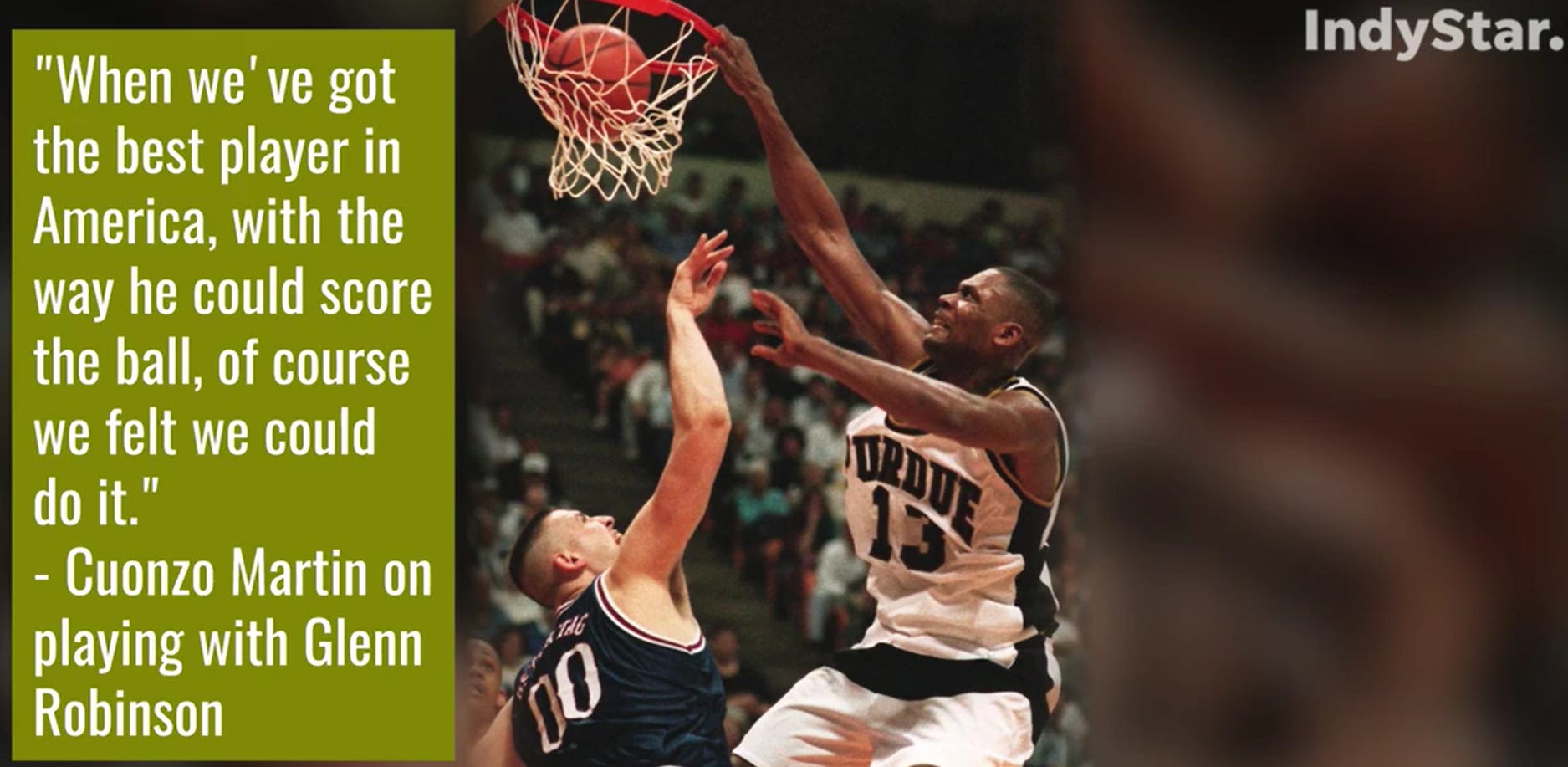
Robinson went No. 1 overall in the draft to Milwaukee, selected ahead of Jason Kidd and Grant Hill. But those two would immediately outpace Robinson, share the Rookie of the Year award and eventually land in the Basketball Hall of Fame. Robinson would finish third in the ROY vote and have a very nice career, playing 11 seasons and making two All-Star teams.
The Bucks did eventually win a couple of playoff rounds. But Robinson might be remembered most for missing this bunny in Game 5 of the 2001 East finals:
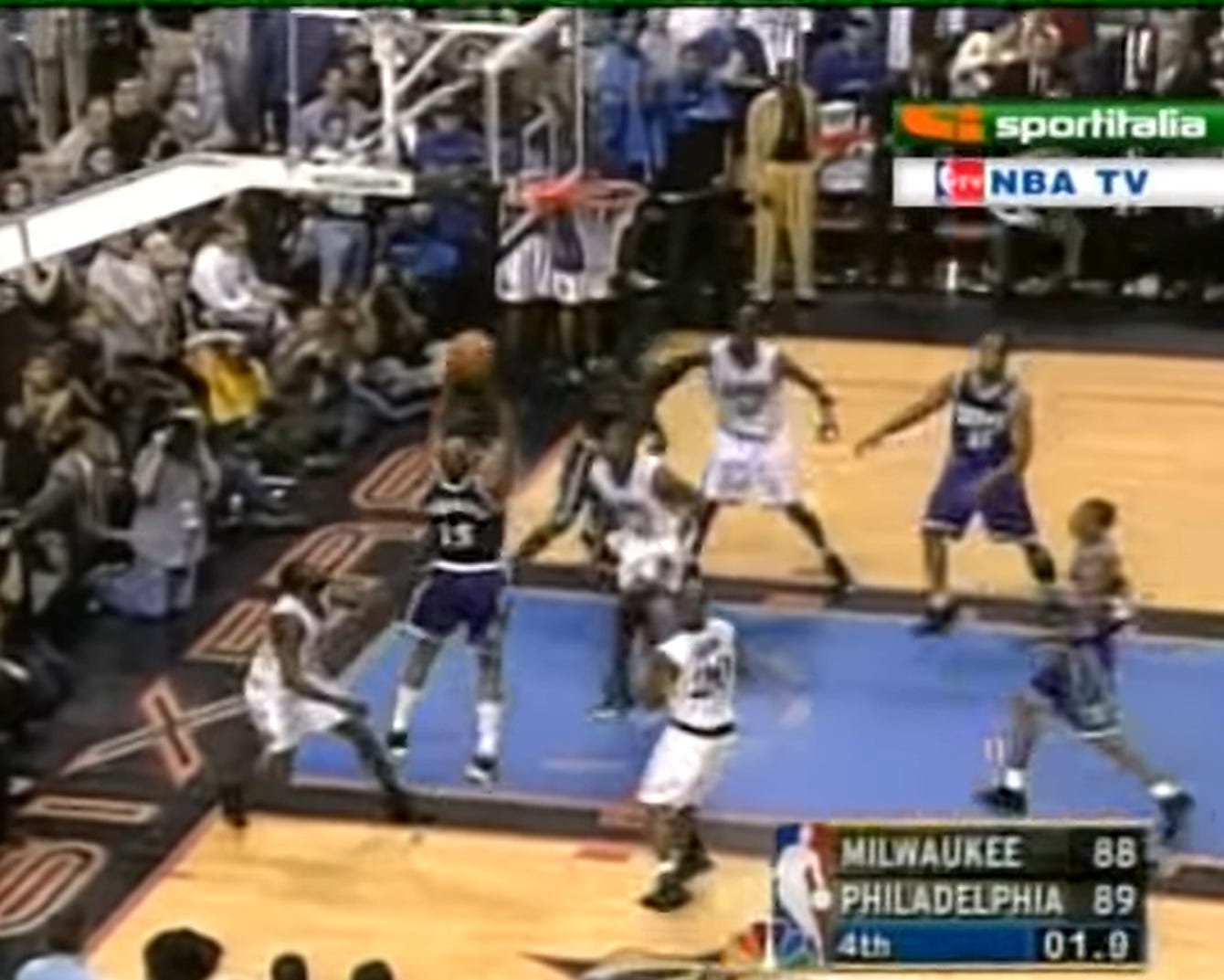
It came as a huge surprise to me and presumably to all Bucks fans when Robinson didn’t become an NBA superstar or even the best player on his team. Rather than showing “man among boys” prowess in the NBA, Robinson was a solid scorer who never truly dominated. His physical advantages from college didn’t map onto the NBA as expected, and he never developed the all-around game to fully compensate.
Cade: “Overpowering”
In 2021, Cunningham was a finalist for the Wooden and Naismith awards and used his physical dominance — he was listed at 6’8” though he’s now listed at 6’6” and 220 lbs. — to become the consensus top pick.
Cunningham passed the eye test with ease and appeared to be a future superstar. “Overpowering” and “a nightmare to defend” were typical descriptions because of his size and skill.
Indeed, the most common comp for Cunningham was Luka Dončić, the hope being that Cunningham’s combination of size, skill and shooting would give Detroit, like Dallas, a do-it-all, heliocentric superstar.
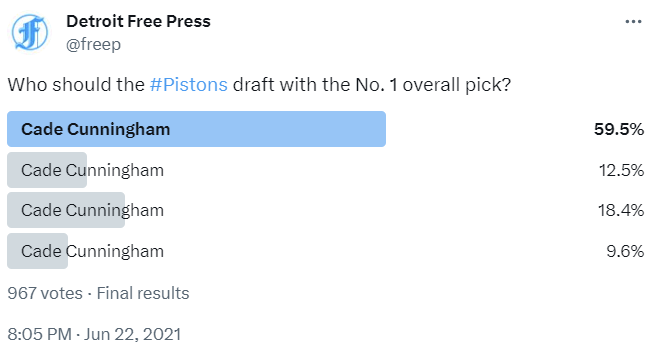
In a draft full of talent at the top, Cade was the easy choice for the Pistons, as this cheeky poll illustrated:
But like Robinson 27 years earlier, Cunningham got off to a rough start and would finish third in the Rookie of the Year voting, behind Scottie Barnes and Evan Mobley.
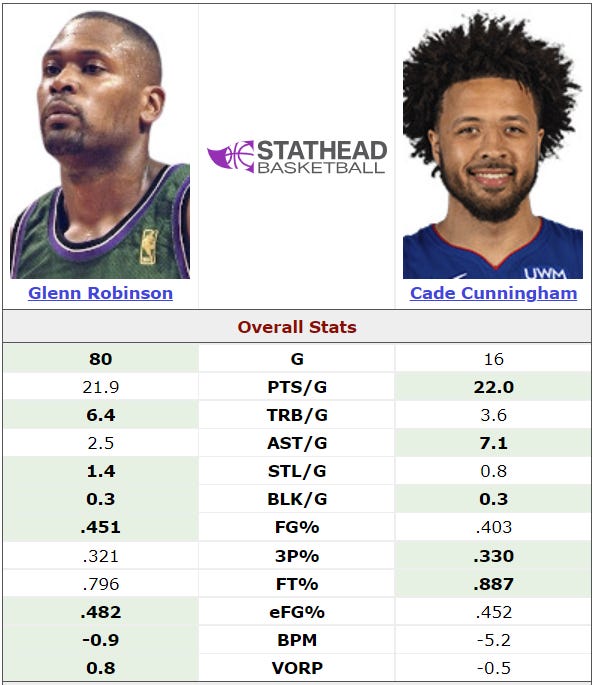
It’s worth noting that Cunningham’s ascent to college stardom was faster than Robinson’s, a point in Cade’s favor. So if we are matching up the two players directly, apples to apples, we can start by comparing Robinson’s rookie year to Cunningham’s third NBA year, which is the age-22 season for each.
Unfortunately, Cade’s third season — the current one — has started rather miserably, and so far does not appear to be the breakout that many of us expected.
Their numbers for their respective age-22 seasons:
A brief origin story
This comp grew out of discussions with Chad Ford, back in 2021, when I was Chad’s editor at NBA Big Board (which is still in operation under Rafael Barlowe, with whom I also work).
During the predraft process, Chad began expressing doubt about whether Cunningham should be the consensus No. 1 overall pick, and that prompted me to do a lot of film study.
About a week before the draft, I texted Chad:
I used to love Big Dog Robinson in college. Watched every game. (I was at a Big Ten school.)
He dominated physically, shot the ball well, was national player of the year and passed the eye test to such a degree that he was a no-brainer No. 1 overall — despite known quantity/Hall of Famers Jason Kidd and Grant Hill sitting right there.
Eventually made two All-Star teams and turned out to be about the fifth-best player from that draft.
I do NOT think Cade is the second coming of Big Dog.
I think "stronger Khris Middleton" or "poor man's KD" is probably more accurate.
But if he disappoints, I think it will be because the Big Dog problem is more important than we realized.
In other words, given he has no really dominant skill, and he won't be as superior physically, what if he's just good rather than overwhelming?
In other words, he will have to evolve, I think.
And that's why it is good he is about two years younger than Robinson when he entered the league. He probably will evolve, mature, improve.
Chad’s reply:
That's exactly the right way to be wary.
And so far, that’s where we are with Cunningham, even if I still have the kind of hope I expressed to Chad about Cade’s eventual status in the league.
What Cade needs: Skill, skill, skill, and more skill
Yes, the Pistons could do more to help Cade by building a competent roster that fits better with his talents. On the other hand, Cade could also do more to help the Pistons. To be blunt, they need him to become the no-doubt star they expected him to be.
Cunningham’s skill level shows both potential and lots of room for growth. Cade’s shooting was considered a plus, and his career FT shooting is better than 85% — he’s at almost 89% this season. That makes this stat hard to believe:

Cunningham plays in a crowd — this is one place the Pistons’ lack of spacing shows up. Still, I’m surprised he hasn’t shown a more reliable shot, whether from outside (31% from 3 for his career) or around the basket. He has the talent to put the ball in the hole more consistently. But for now, long 2s seem like his comfort zone — another way he’s like Big Dog — which is a reason Cunningham rates so poorly by efficiency metrics, just as Robinson punched below his weight in terms of offensive efficiency.
Furthermore, one reason Cunningham hasn’t yet shown the ability to use his big frame is that his handle just isn’t tight enough. Like Steph Curry, Cunningham can be a turnover machine: Cade’s third in the NBA in turnovers per game over the past three seasons. But unlike Curry, whose dribbling exhibitions are a show, Cunningham can’t really “get wherever he wants to get” via the bounce.
And unlike Curry, who was not a great finisher out of college but worked on his strength and touch to become elite at the rim, Cunningham hasn’t shown the craft to finish at the basket consistently.
But let’s look at the Cunningham cup as half full. He has the opportunity to make the Big Dog comp look silly. Cade’s not doomed to disappoint.
The path is clear, and it requires skill development: With a better handle, more reliable shooting both inside and outside, and the passing prowess he’s already shown, Cade has enough game to become the offensive superstar we hoped he could be. He’s also got more defensive potential than Robinson ever showed.
Cade is barely 22, and he’s played just 92 games. Time is on his side.
Prediction: Cade will be an All-Star eventually
I’m bullish on Cunningham. I think he will become an All-Star, even if his lack of progress is alarming.
But if he can’t rely on physical dominance in the NBA — after he appeared to have nearly unlimited potential to dominate — he’ll have to develop an undeniable set of skills.
Let’s hope he does. That’s a player I want to see.